

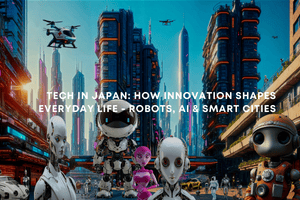
Tech in Japan: How Innovation Shapes Everyday Life - Robots, AI & Smart Cities
Japan is recognized as one of the world’s most technologically advanced country. Japan Tour Packages offers travelers to experience Artificial intelligence (AI) that anticipates traffic patterns and humanoid robots that greet passengers at train stations are just two examples of how Japan’s innovation eco-system is redefining how technology permeates everyday life.
Today, in this guide by Fly For Holidays we examine how robots, artificial intelligence (AI), smart cities, automation, and futuristic infrastructure are influencing daily life in Japan. We also highlight the trends that will propel Japan’s technological innovation in 2026 and beyond.
Introduction – Japan’s Technological DNA
It is no coincidence that Japan is regarded as a world leader in technological innovation. The country is at the vanguard of the Fourth Industrial Revolution thanks to decades of investment in digital infrastructure, consumer electronics, automotive technology, robotics, and artificial intelligence.
Global tech indexes and reports on digital adoption show that Japan routinely scores highly in:
Robotics adoption
AI research output
Smart city development
High-speed connectivity
Innovation ecosystems
These pillars are ingrained in the way Japanese people live, work, and travel; they are not merely economic factors.
Tip: Keep your Japanese Visa ready, so you won’t miss this amazing tech experience!
Let Our Japan Tour Package Expert Call You
Robots in Japan: Everyday Helpers, Not Sci-Fi Dreams
On a Japan Trip, the majority of people associate robots with futuristic humanoids. However, in reality, Japanese robots are ubiquitous, highly functional, and useful.
- Service Robots and Hospitality Innovation
Robots have been incorporated into regular customer service in Japan, particularly in restaurants, hotels, and airports. Robots are used to greet visitors, transport bags, and provide multilingual information. These service robots enhance customer satisfaction and address labor shortages.
Key examples include:
- Natural language processing (NLP) robots for multilingual assistance
- Automated tour guides at tourist locations
- Food and drink delivery robots in hotels and cafés
These developments have garnered international attention and fueled developments in AI-powered automation and robot customer service.
- Industrial Robots — The Backbone of Japanese Manufacturing
Some of the most cutting-edge producers of industrial robots, including global leaders in:
- Automotive production automation
- Precision assembly lines
- Smart factory robotics
These developments have made Japanese manufacturing robots some of the most effective in the world, supporting global supply chains and enhancing Japan’s position as a major player in the global technology industry.
- Humanoid Robots — From Research to Reality
Although humanoid robots like SoftBank’s Pepper and Honda’s ASIMO went viral, their actual worth is found in practical uses:
- Assisting elderly people
- Ward rounds in hospitals
- Educational roles in schools
Humanoid robots from Japan combine practical robotics, a developing field in consumer and commercial technology, with emotional artificial intelligence.
Artificial Intelligence (AI) — Powering Smart Solutions
In Japan, artificial intelligence (AI) is more than just a catchphrase; it is a fundamental technology influencing consumer applications, public services, and industries.
- AI in Healthcare and Elder Care
Japan, which has one of the fastest-aging populations in the world, has looked to artificial intelligence (AI) to improve senior care and healthcare delivery. AI is employed in:
- Monitor patient health metrics in real-time
- Predict health risks using predictive analytics
- Provide companionship and cognitive support
These developments fit into Japan’s larger plan to develop AI-powered healthtech products that enhance people’s quality of life.
- AI-Driven Transportation Systems
From urban buses to bullet trains, Japan’s transportation system uses cutting-edge AI to increase dependability, efficiency, and safety.
Examples include:
- AI-based route optimization
- Predictive maintenance on train systems
- Traffic flow prediction in cities
Japan has distinguished itself in international AI mobility rankings thanks to its emphasis on smart transportation.
- AI in Business Intelligence and Commerce
Japanese businesses are using AI to boost their competitiveness by:
- Data-driven decision making
- Customer behavior prediction
- Automated digital marketing systems
AI enables businesses to run more intelligently and effectively in a variety of industries, including retail and logistics. This is one of the main reasons Japan is still at the forefront of digital transformation.
Building Smart Cities — Japan’s Vision for Future Urban Living
Japan is already setting the standard for smart cities, which are the way of the future for urban planning.
- What Is a Smart City?
Technology, particularly IoT, AI, and big data, is used in smart cities to enhance economic performance, sustainability, and quality of life. The main goals of Japan’s smart city projects are:
- Energy efficiency
- Intelligent traffic and mobility
- Smart utilities and services
- Sustainable urban planning
- Futuristic Projects: From Tokyo to Fukuoka
Japan is working on several smart city projects, such as:
- Tokyo Smart City Programs – integrating smart grids and IoT systems
- Fukuoka City innovation hubs – piloting urban mobility tech
- Machine learning-based regional smart projects that maximize energy use
Japanese cities are becoming actual laboratories of future living thanks to these developments.
- Smart Infrastructure and 5G Connectivity
The widespread rollout of 5G networks in Japan has made it possible for:
- Faster and more reliable digital communication
- Real-time IoT device data transmission
- AI-driven urban infrastructure monitoring
Services like drone delivery and driverless cars depend on this connectivity backbone.
Autonomous Vehicles — Japan’s Next Mobility Revolution
Japan has long been at the forefront of automotive innovation. These days, autonomous vehicles (AVs) are part of that leadership.
- Self-Driving Cars and Public Transportation
Businesses like Nissan, Toyota, and Honda are making significant investments in:
- Level 4 and Level 5 autonomous driving tech
- AI navigation systems
- Safety sensors and advanced perception algorithms
It is anticipated that these cars will improve road safety and transform urban commuting, particularly in densely populated city centers.
- Robotaxis and Shared Mobility
Robotaxis, autonomous ride-hailing services that integrate AI, mapping technology, and real-time traffic analytics, is being tested in Japan. This environment facilitates:
- Reduced traffic congestion
- Lower emissions
- More accessible mobility
Self-driving cars are seen by urban planners as a necessary component of smart mobility systems in the future.
Tech and Daily Life — How Innovation Touches Every Person
The profound impact of Japan’s technological ecosystem on daily life is one of its most notable features.
- Smart Homes and IoT Devices
IoT devices have become commonplace, from voice-activated assistants in Japanese homes to refrigerators that keep track of shopping lists.
- Smart appliances connected through Wi-Fi
- AI-powered language assistants
- Automated home energy management
These innovations show how AI and IoT improve efficiency and convenience in home settings.
- Digital Payments and Cashless Society
Japan is moving quickly in the direction of cashless transactions:
- Contactless credit and debit systems
- QR code mobile payments
- AI-powered fraud protection
This change promotes Japan’s efforts to become a more digital economy while also improving convenience.
- Education and Tech Literacy
Japanese universities and schools are merging:
- Robotics classes
- AI programming curriculums
- Innovation labs
Japan’s innovation cycle is strengthened by this investment in tech education, which guarantees that the next generation is prepared for careers in robotics, data science, and artificial intelligence.
Innovation in Industry — Japan’s Tech Powerhouses
Global standards are still set by Japan’s leading tech companies and organizations.
- Consumer Electronics Giants
Businesses like Sony, Panasonic, and Toshiba are still leading the way in:
- High-resolution displays
- Wearable tech
- Smart appliances
Here, innovation boosts global brand influence and propels exports.
- Automotive Tech and Electric Vehicles
Leading the way in electric and hybrid vehicle electrification is Japan’s automaker sectors combining robotics, AI, and battery technology creating a new era of smart transportation.
Challenges and the Road Ahead
While no innovation has been without obstacles, Japan faces several current impediments to its advancements.
- Aging population impacting workforce dynamics
- Competition from global AI hubs
- Regulatory barriers for autonomous technologies
Nevertheless, through strategic investments in AI research; developing a standardization for robotics, creating smart city frameworks, and providing digital literacy skills, Japan is positioned favorably to stay in front of world trends.
Let Our Japan Tour Package Expert Call You
Why Japan’s Tech Future Matters to the World
The technological innovations created in Japan are not isolated to Japan’s borders; they are applicable on a global scale. Countries around the world studying Japan’s models include:
Smart city blueprints for sustainable growth
Robotics integration for elderly care
AI ethics and safety frameworks
Autonomous vehicle deployment strategies
Japan’s approach to balancing tradition with modern technology offers a guidepost for other countries facing the challenge of going through the digital transformation process.
Conclusion – A Country Where Tomorrow Arrives Early
From robots welcoming commuters to AI systems running optimally on a “real-time” basis, Japan is continually at the forefront of technological innovations. The country’s commitment to creating smart cities and developing robotics and autonomous technology with AI solutions has transformed everyday life, increased economic productivity, and has established a standard for global innovation.
If you are someone who has interest in the type of technology that will have an impact on how you live your daily life, Japan is more than just a place to visit; it is a world class example of what is possible through technology today.
Tech in Japan: How Innovation Shapes Everyday Life - Robots, AI & Smart Cities Faq's
Japan is one of world’s leading innovators across all sectors by leveraging its strong research programs in numerous disciplines including robotics and AI, smart city applications, urban transportation systems, and advanced manufacturing. The Japanese Government has invested extensively, keeping Japan on the cutting edge of technology developed to enhance productivity and efficiency across nearly every sector.
Robots are commonly found in Japanese hotels, restaurants, hospitals, factories, etc. They perform functions ranging from assisting customers to caring for the elderly and delivering food. The prevalence of robots throughout Japan make it easier for people to conduct daily activities and contribute to the general quality of life.
Japan uses AI in many different areas including transportation, healthcare, retail, finance, and smart city systems. Development of AI technology will allow for the improvement of traffic systems, more accurate medical diagnoses, better customer service, etc.
There are humanoid robots in Japan, built to imitate human physical characteristics and behaviours. The most well-known humanoid robots in Japan include Honda’s ASIMO and Softbank Robotics’ Pepper. These types of robots are primarily utilized in the fields of customer service, healthcare, research, and public service.
Many autonomous vehicles, both self-driving cars and robotic taxis, are currently being tested at various locations in Japan, particularly large urban areas and during periods of high profile special events. Many of the major auto manufacturers based in Japan (Toyota and Nissan, to name two) are investing heavily in the development of autonomous vehicle technology.
5G will enable businesses in Japan to communicate at much higher speeds, leverage the increasing capabilities of IoT technologies for smart city development, and process large volumes of real-time data from AI technologies at the moment it is made available.
Sony, Panasonic, Toshiba, Toyota, and Honda are among Japan’s largest technology and innovation companies.
Robotics, AI automation, and smart systems are being utilized in Japan as a way to deal with the diminishing number of workers due to an aging population. Service robots and automated manufacturing facilities are playing a significant role in this issue.
Industries in Japan that are benefiting from the use of AI include healthcare, automotive, manufacturing, retail, finance, logistics, and smart city development.
AI is assisting Japan with predictive diagnostics in healthcare, monitoring of patients remotely, care for older adults using robotics, and automating operations in hospitals among other things. AI-based programs are intended to reduce the negative effect of Japan’s aging population.

Comment (0)