

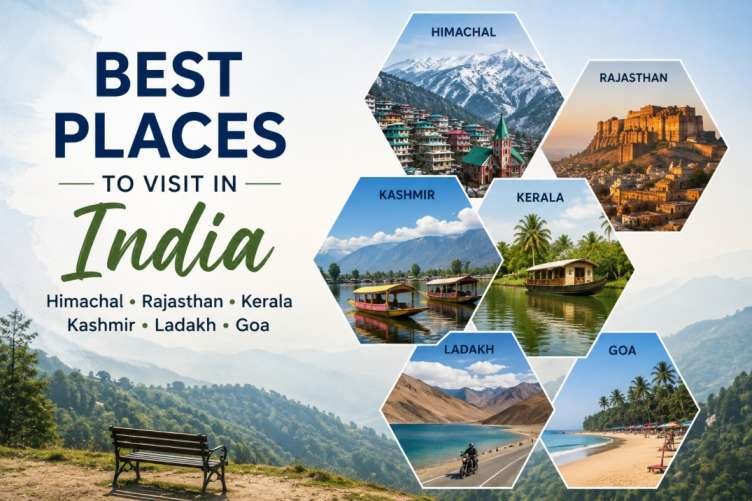
India rewards travellers who go deep rather than wide, and these six regions are where that pays off most. Each one is genuinely different — high-altitude desert in Ladakh, alpine valleys in Kashmir, accessible hill stations in Himachal, heritage and desert landscape in Rajasthan, backwaters in Kerala, and beaches in Goa. This guide covers what to actually expect from each, when to go, how long to budget, and who each destination suits — the kind of planning detail most destination lists skip in favor of longer checklists.
Rajasthan
Best time to visit Rajasthan: October to March. April to June regularly exceeds 40°C, which makes daytime sightseeing genuinely difficult rather than merely uncomfortable.
How many days do you need in Rajasthan? 8–10 days for a full Jaipur–Jodhpur–Jaisalmer–Udaipur circuit; 4–5 days if you’re focusing only on Jaipur and Udaipur. Rajasthan is India’s most complete heritage state, built around forts, palaces, and desert landscape that trace a fairly continuous Rajput history back to the 6th century.
Jaipur, the Pink City, anchors most trips — Amber Fort, City Palace, and Hawa Mahal’s honeycomb facade are the headline sights, but the old city’s working bazaars are worth a half-day on their own.
Udaipur, built around Lake Pichola, is where the state turns unmistakably romantic — the City Palace rises straight from the water, and rooftop dinners overlooking the lit-up palace at night have made it Rajasthan’s default honeymoon city.
Jaisalmer, deep in the Thar Desert near the Pakistan border, offers something the other cities can’t: a sandstone fort still genuinely inhabited by families and shops, plus overnight camel-safari camps in the surrounding dunes.
Jodhpur, the Blue City, sits between the two — Mehrangarh Fort towering over an indigo-painted old town, with a quieter, less touristed feel than Jaipur. Beyond the four main cities, Ranthambore and Sariska National Parks add tiger-sighting wildlife tourism, and Pushkar’s camel fair (usually held in November) is one of India’s most distinctive cultural events for travellers who can time a visit around it.
Rajasthan for families: Jaipur and Udaipur work well for families with school-age children, since forts and palaces give tangible, memorable landmarks rather than abstract sightseeing. Rajasthan for couples: Udaipur specifically, though pairing it with Jaipur for two contrasting cities within one trip is common.
Our Rajasthan tour packages are built around this exact four-city circuit, with options to extend into Ranthambore or Pushkar depending on trip length and timing.
Let Our Domestic Tour Package Expert Call You
Kerala
Best time to visit Kerala: September to March for standard sightseeing. June to August (monsoon) specifically for travellers interested in Ayurveda, since the humidity is considered ideal for certain treatments, and for a genuinely lush, quieter version of the state.
How many days do you need in Kerala? 6–8 days to properly cover backwaters, a hill station, and one city without rushing. Kerala runs on a different travel logic from the rest of this list — much of it is best seen by water rather than road. The backwaters around
Alleppey and Kumarakom form a network of canals and lagoons best explored aboard a traditional houseboat (kettuvallam), converted from a rice barge into a slow-moving floating hotel; a one- or two-night stay drifting past coconut groves is consistently the most-recommended single Kerala experience.
Munnar, up in the Western Ghats, brings tea-plantation hills and cooler air, with Eravikulam National Park nearby for hiking and a chance to see the endangered Nilgiri tahr.
Kochi (Cochin) layers Portuguese, Dutch, and British colonial history over a working harbor — the Chinese fishing nets along the waterfront and Fort Kochi’s art and food scene make it Kerala’s most walkable city stop. For travellers with extra time,
Wayanad and Vagamon offer quieter, less-visited hill-station alternatives to Munnar, and Kumarakom’s bird sanctuary adds a wildlife layer to a backwaters stop.
Kerala for couples: the backwaters, specifically a private houseboat stay, are the standout choice — quiet, scenic, and genuinely different from anywhere else in India.
Kerala for families: the slower pace and combination of nature, water, and hill stations suits families well, particularly those with younger children who do better with a less packed itinerary.
Our Kerala tour packages include dedicated houseboat-stay itineraries alongside standard Munnar–Kochi sightseeing circuits.
Himachal Pradesh
Best time to visit Himachal Pradesh: March to June for general sightseeing; December to February for snow in Manali and Shimla. Spiti Valley is largely inaccessible in deep winter due to road closures.
How many days do you need in Himachal Pradesh? 5–7 days covers Manali and Shimla comfortably; add 3–4 days for Spiti Valley, which requires significant additional travel time. Himachal Pradesh is the most accessible introduction to the Himalayas India offers.
Manali sits at the center of most itineraries, with paragliding, river rafting on the Beas, and short treks into Solang Valley that don’t require serious mountaineering experience. From Manali, the road toward
Spiti Valley trades green hillsides for a high-altitude cold desert — monasteries, barren passes, and villages that see comparatively few visitors even in peak season, with Kaza as the region’s main hub.
Shimla, the former colonial summer capital, offers an entirely different pace: Victorian-era architecture along the Mall Road and the UNESCO-listed Kalka–Shimla toy train.
Dharamshala and McLeod Ganj, home to the Dalai Lama and a Tibetan exile community, draw longer-staying travellers for meditation, Tibetan food, and moderate trekking into the Dhauladhar range.
Dalhousie and Bir Billing (a major paragliding hub) round out the state’s range for travellers wanting quieter hill towns or a specific adventure-sport base.
Himachal for families: Manali and Shimla, given their infrastructure and lower altitude, without the acclimatization demands of Spiti.
Himachal for adventure travellers: Bir Billing for paragliding, Manali for rafting and short treks, Spiti for high-altitude trekking. Our Himachal Pradesh tour packages cover both the accessible Manali–Shimla circuit and extended Spiti Valley routes.
Kashmir
Best time to visit Kashmir: April to October for general sightseeing and gardens in bloom; December to February specifically for Gulmarg’s ski season.
How many days do you need in Kashmir? 5–6 days cover Srinagar, Gulmarg, and Pahalgam properly.
Kashmir’s “paradise on earth” reputation is well-earned — alpine lakes, pine forests, and Mughal-era gardens give the Kashmir Valley a genuinely different character from the rest of India.
Srinagar centers around Dal Lake, where staying aboard a traditional houseboat remains one of the most distinctive stays in the country, and a sunrise shikara ride past the floating vegetable market is a genuine local institution rather than a tourist add-on.
Gulmarg, about an hour away, is India’s premier winter-sports destination, home to one of the world’s highest cable car systems and serious skiing terrain; in summer, the same slopes become strong short-trek and golf terrain.
Pahalgam, further east along the Lidder River, offers a gentler, greener alternative with meadows, pony treks, and access to the Amarnath Yatra pilgrimage route. Travellers combining spirituality with the trip often add
Vaishno Devi, near Katra in Jammu, one of India’s most-visited Hindu pilgrimage sites. Kashmir for couples: Srinagar’s houseboats and Mughal gardens are consistently the top honeymoon pick in the region.
Kashmir for winter-sports travellers: Gulmarg specifically, during the December–February ski season.
Our Kashmir tour packages cover the Srinagar–Gulmarg–Pahalgam circuit with houseboat-stay options built in, and can extend to include Vaishno Devi.
Ladakh
Best time to visit Ladakh: May to September, when road passes are open, and weather is stable. Winter travel (the Chadar Trek season, December–February) exists for a small, experienced-trekker niche and isn’t suitable for general travel.
How many days do you need in Ladakh? 7–8 days minimum, including at least one full acclimatization day in Leh before onward travel. Ladakh is the most demanding and most rewarding destination on this list. Sitting between 3,000 and 5,000+ meters, it’s a high-altitude cold desert that feels closer to the Tibetan plateau than to the India most travellers picture.
Leh, the region’s main town, is where almost every itinerary starts — and where most first-time visitors make their biggest planning mistake by skipping the acclimatization day nearly every guide and local operator recommends before pushing to higher altitudes.
Pangong Lake, roughly five hours from Leh, is Ladakh’s most photographed feature, its water shifting through shades of blue and turquoise across the day.
Nubra Valley, reached via Khardung La — long promoted as one of the world’s highest motorable passes — adds sand dunes and Bactrian camels, a legacy of the old Silk Route trade. For travellers with extra time, Zanskar and Tso Moriri offer a more remote, less-visited version of the same high-altitude landscape. Ladakh’s monasteries — Thiksey, Hemis, and Diskit among the most visited — remain active religious institutions, and timing a trip around the Hemis Festival (usually June or July) adds a genuine cultural layer beyond scenery.
Ladakh for adventure travellers: road trips via Manali or Srinagar, motorbiking, and high-altitude trekking are the primary draw. Who Ladakh doesn’t suit well: young children, elderly travellers, or anyone with cardiac or respiratory conditions, given the altitude risk — worth stating plainly rather than glossing over, since altitude sickness is the most common reason trips get cut short.
Our Ladakh tour packages build in proper acclimatization scheduling rather than compressed itineraries that increase altitude-sickness risk.
Goa
Best time to visit Goa: November to February for the most comfortable weather and peak nightlife season. June to September (monsoon) turns the state dramatically green and quiet, though many beach shacks close for the season.
How many days do you need in Goa? 4–5 days for one half of the state properly; 6–7 days to split comfortably between North and South Goa.
Goa remains India’s most straightforward beach destination, and its enduring popularity comes down to genuine range within a small geography.
North Goa — Baga, Calangute, Anjuna — is the livelier half: beach shacks, water sports, flea markets, and a nightlife scene central to Goa’s identity since the 1990s trance-party era.
South Goa — Palolem, Agonda, Colva — trades that energy for quieter sand, more upscale resorts, and a noticeably slower pace, making the two halves suited to almost opposite kinds of traveller despite sitting barely an hour apart.
Old Goa carries the state’s Portuguese colonial history in genuinely striking form — the Basilica of Bom Jesus and Sé Cathedral rank among the largest churches in Asia, a reminder that nearly 450 years of Portuguese rule shaped Goa as much as its coastline did. That history shows up in the food too: Goan cuisine’s use of vinegar, pork, and coconut is a genuinely distinct culinary tradition worth planning meals around.
Goa for couples and friend groups: North Goa for nightlife and energy, South Goa for a quieter, more romantic pace. Goa for families: South Goa generally, given the calmer beaches and more resort-style infrastructure.
Our Goa holiday packages offer both North and South Goa itineraries, plus combined packages that split time between the two.
Let Our Domestic Tour Package Expert Call You
Comparing the Six Destinations
Destination | Best For | Best Time to Visit | Ideal Trip Duration | Travel Style |
Rajasthan | Heritage lovers, couples, families | October–March | 8–10 days | Cultural, sightseeing-heavy |
Kerala | Couples, honeymooners, wellness travellers | September–March (or monsoon for Ayurveda) | 6–8 days | Slow travel, water-based |
Himachal Pradesh | Families, adventure travellers, honeymooners | March–June, Dec–Feb (snow) | 5–7 days | Moderate activity, accessible hills |
Kashmir | Couples, winter-sports enthusiasts | April–October (sightseeing); Dec–Feb (skiing) | 5–6 days | Scenic, relaxed pace |
Ladakh | Adventure travellers, photographers, solo trekkers | May–September | 7–8 days minimum | High-altitude, physically demanding |
Goa | Couples, friend groups, families | November–February | 4–7 days | Beach and leisure |
Which of These Six Should You Choose?
For a first Himalayan trip, Himachal is the more forgiving entry point — Ladakh’s altitude and Kashmir’s more variable travel conditions both ask more of a first-timer. For concentrated heritage and architecture, Rajasthan outdoes every other state on this list. Couples planning a honeymoon specifically tend to choose between Udaipur, Kerala’s backwaters, or Kashmir’s houseboats — each delivers a genuinely different romantic backdrop, so it’s worth deciding whether you want palaces, water, or mountains first.
Families with young children generally do best in Goa, Kerala, or Himachal, since Ladakh’s altitude and Kashmir’s longer travel days ask more of younger travellers. For a longer, multi-region trip, Rajasthan pairs naturally with a Kerala or Goa extension — heritage and desert followed by something coastal or slow-paced makes for a genuinely complementary contrast rather than more of the same.
Planning Your Trip
Ladakh’s road-access windows, Kashmir’s seasonal shifts, and Rajasthan’s summer heat all mean when you go matters as much as where. For multi-destination trips, coordinating flights, hotels, and ground transport as a single itinerary — rather than booking each leg independently — tends to save both time and money, and avoids the scheduling gaps that eat into a short trip. If you’re planning a custom multi-region itinerary across any combination of these six, our customized India tour packages are built specifically around this kind of trip.
Best Places to Visit in India: Himachal, Rajasthan, Kerala, Kashmir, Ladakh & Goa Faq's
Rajasthan or Kerala tend to work best — both have well-developed tourist infrastructure and don’t require Ladakh’s altitude acclimatization or Kashmir’s seasonal planning.
Yes, with proper planning. The main risk is altitude sickness rather than terrain difficulty — building in at least one full acclimatization day in Leh before travelling further, staying hydrated, and avoiding overexertion in the first 48 hours significantly reduces risk. Travellers with cardiac or respiratory conditions should consult a doctor before booking.
Udaipur, Kerala’s backwaters, and Kashmir’s Dal Lake houseboats are the three most commonly chosen honeymoon destinations among these six, each offering a distinctly different romantic setting.
The Srinagar–Leh road connects both during the open-road season (roughly June to September). Combining them typically needs 10–12 days total and careful altitude planning when moving from Kashmir into Ladakh, since Kashmir sits at a much lower elevation.
There isn’t one — that’s the core planning challenge. May through June offers the best overlap (Ladakh’s roads open, Kashmir and Himachal are pleasant), though Rajasthan and Goa are past their ideal window by then, which is why most travellers choose one or two regions per trip rather than attempting all six at once.

Comment (0)